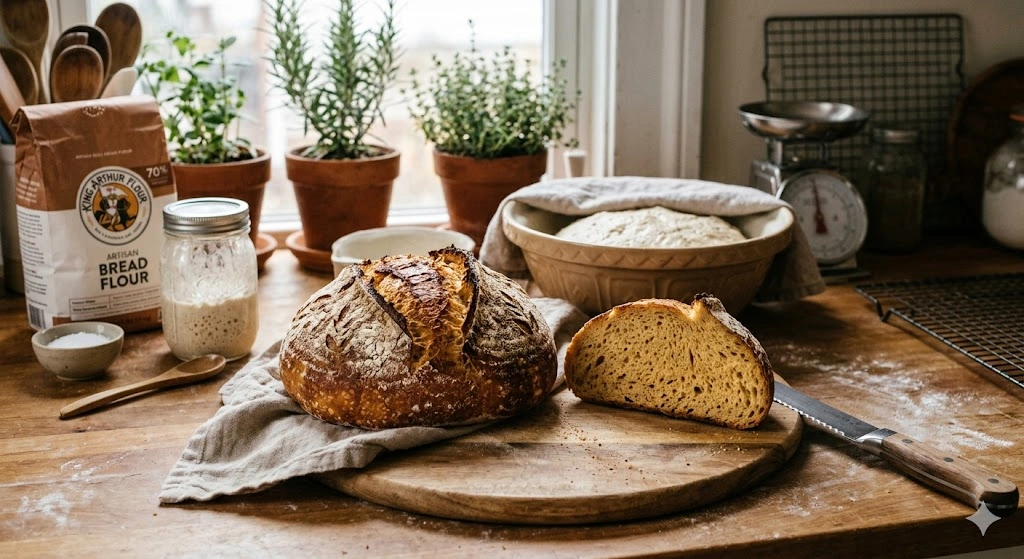
In a large bowl, mix sourdough starter and water until fully dissolved and milky-looking. The mixture should feel smooth before adding flour.
Add bread flour and salt, then mix until a shaggy, stiff dough forms. It will look dry and rough at first, which is normal for low hydration dough.
Cover and let the dough rest for 20–30 minutes so the flour fully absorbs the water and becomes easier to handle.
Perform 3–4 sets of stretch and folds every 30 minutes. The dough will gradually become smoother, stronger, and slightly elastic.
Allow bulk fermentation for 4–12 hours depending on room temperature. The dough should look slightly puffed with small air pockets forming.
Shape the dough into a tight round or batard, making sure the surface feels firm and holds tension without sticking excessively.
Place in a floured banneton and proof until slightly risen and jiggly, usually 1–2 hours or overnight in the fridge.
Preheat oven to 450°F (230°C) with Dutch oven inside for at least 30 minutes before baking.
Score the dough with a sharp blade, then bake covered for 30 minutes and uncovered for 10–15 minutes until deep golden brown.
Cool on a wire rack for at least 1 hour before slicing to allow crumb structure to set properly.