Oven Cooked Bacon Recipe: 5 Tips to Avoid Soggy Strips

There’s something about the smell of bacon slowly rendering in the oven that feels like a weekend morning done right. It’s savory, a little smoky, and unmistakably comforting. For years I stood over a skillet, dodging splatter and flipping strips one by one. Then I switched to this oven cooked bacon recipe and I never went back.
Oven baked bacon is flatter, more evenly cooked, and dramatically less messy than stovetop bacon. You can make large batches for brunch, meal prep, or a holiday breakfast without hovering over a pan. And when it’s done right, you get that perfect balance: deep golden brown edges, crisp centers, and beautifully rendered bacon grease you can actually save.
If you’ve ever burned a whole package at 400°F or ended up with limp, undercooked strips, this guide will walk you through exactly what’s happening and how to fix it.
What Is Oven Cooked Bacon Recipe and Why It’s Popular
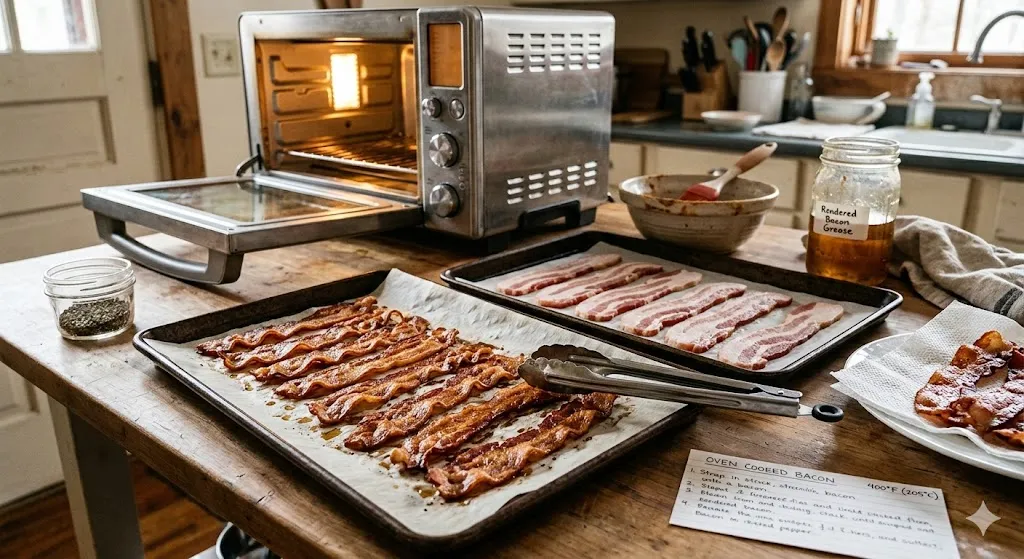
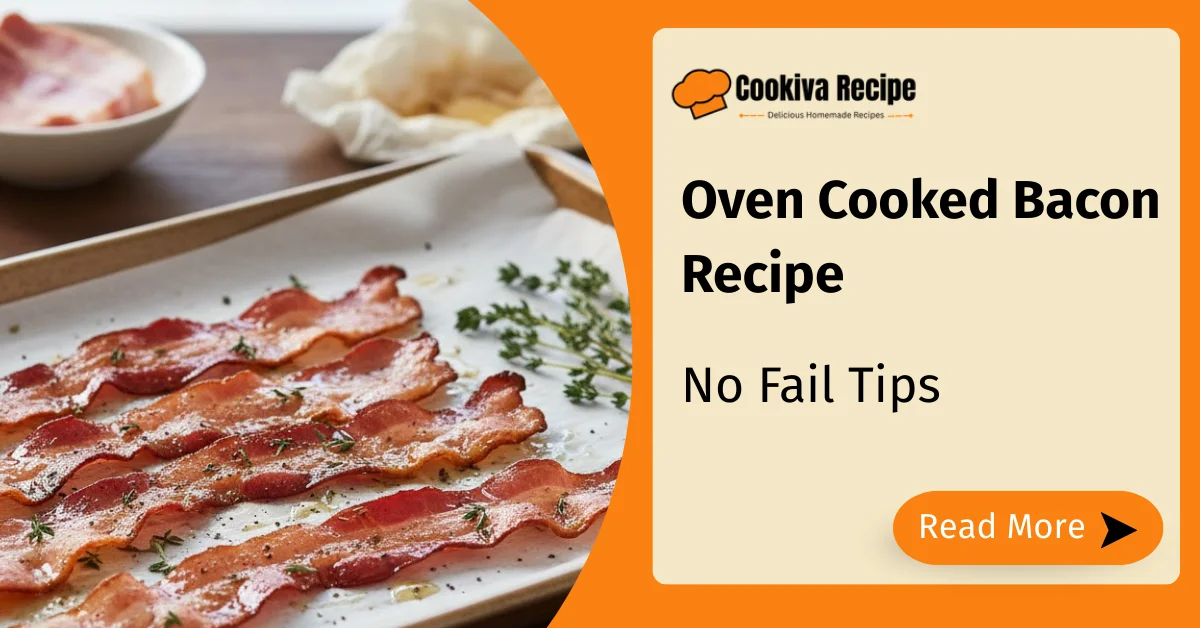
An oven cooked bacon recipe is exactly what it sounds like: instead of frying sliced pork bacon in a skillet or on a griddle, you lay it in a single layer on a sheet pan and bake it until the fat renders and the meat browns.
It’s popular for one simple reason: control. The oven surrounds the bacon with steady heat, which means it cooks more evenly and stays flat. There’s no curling, no constant flipping, and far less splatter compared to the stovetop.
It’s especially loved for feeding a crowd. Whether you’re hosting brunch for eight or prepping a week of breakfast sandwiches, oven baked bacon makes it possible to multitask in the kitchen without sacrificing texture.
If you love hearty breakfast classics, this Shit on a Shingle Recipe delivers creamy comfort and nostalgic flavor with surprisingly simple ingredients.
Why You Should Oven Cooked Bacon Recipe (And When It’s Better Than a Skillet)
The biggest advantage is consistency. In the oven, the heat is distributed more evenly, which means your bacon reaches your desired level of crispiness across the entire strip.
It’s also:
- Hands free
- No splatter across your stovetop
- Easier for large batches
- Less likely to burn in isolated spots
- Perfect for thick cut bacon
If you’re cooking 1 lb bacon for 4 servings or prepping for brunch, the oven wins every time.
How to Keep Your Oven Clean When Baking Bacon
Grease splatter is the number one complaint with oven baked bacon. The good news? It’s manageable.
Here are the most effective solutions, ranked by practicality:
- Parchment paper lining (Best balance of easy + effective)
Line your sheet pan fully. It reduces sticking and catches grease. - Loose foil tent method (Most effective)
Lightly tent aluminum foil over the bacon without sealing it tightly. This prevents splatter but still allows steam to escape. - Lower temperature baking (350°F)
Cooking at 350°F instead of 400°F significantly reduces splatter because fat renders more slowly. - Use thick cut bacon
Thick cut bacon splatters less due to lower surface moisture exposure.
Avoid silicone baking mats, grease pools heavily and the bacon can fry unevenly.
Recipe Overview: Flavor, Texture, and When This Works Best
This oven cooked bacon recipe produces bacon that’s evenly cooked, deeply savory, and customizable from the softer side of crispy to super crispy. The edges turn golden brown, and at 400°F they develop a deeper, slightly caramelized finish thanks to the Maillard reaction.
This method shines for:
- Weekend breakfast
- Meal prep
- Holiday brunch
- Cooking for a crowd
- Recipes that need flat bacon
Quick Summary
| Prep Time | Cook Time | Total Time | Servings | Difficulty | Cuisine |
| 5 minutes prep | 15 to 20 minutes cook | 20–25 minutes total | 4 servings | Easy | American |
Ingredients and Why Each One Matters
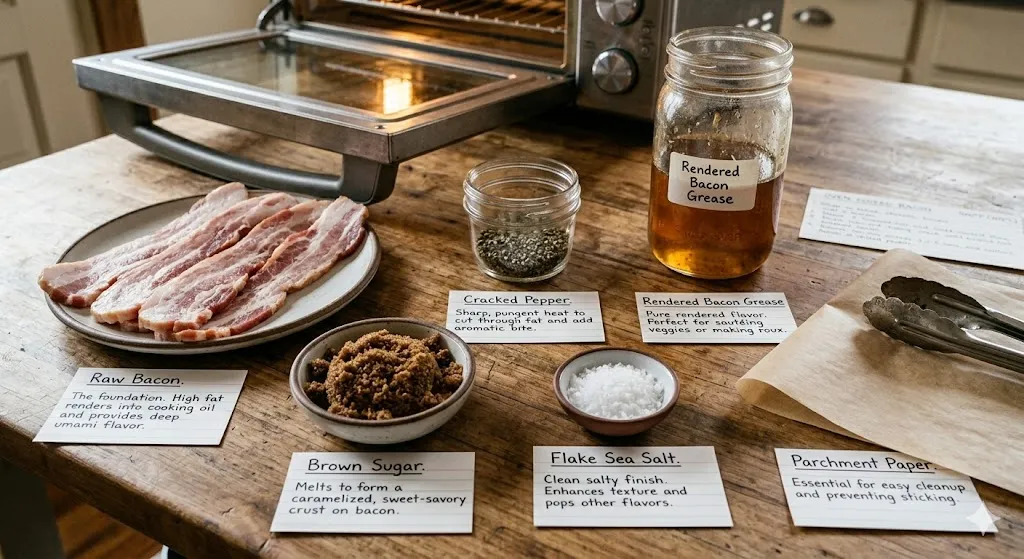
Good bacon needs very little.
- 1 lb bacon (about 8–12 slices) Thick cut bacon takes 20 to 25 minutes; regular cut takes 12 to 17 minutes at 400°F.
- Optional: black pepper, maple syrup, brown sugar (for variations below)
Organic bacon and center cut varieties behave slightly differently due to fat ratio. Turkey bacon requires lower heat and shorter time.
What You’ll Need (And Why Equipment Matters)
| Equipment | Works Well? | Pros | Cons | Temp/Time Adjustment |
| Heavy duty baking sheet | Yes | Even heat | None | Standard |
| Rimmed baking sheet | Yes | Contains grease | Slight pooling | Standard |
| Cooling rack on sheet pan | Yes | Crispier underside | More cleanup | +2 minutes |
| Glass/Pyrex dish | Okay | Accessible | Bacon sits in grease | Reduce temp to 375°F |
| Toaster oven | Yes (small batches) | Convenient | Hotter heating elements | Reduce time 10–15% |
| Air fryer tray | Yes | Fast | Can overcook | Check at 8–10 minutes |
Dark pans run hotter and reduce cooking time slightly.
How to Make This Oven Cooked Bacon Recipe the Right Way
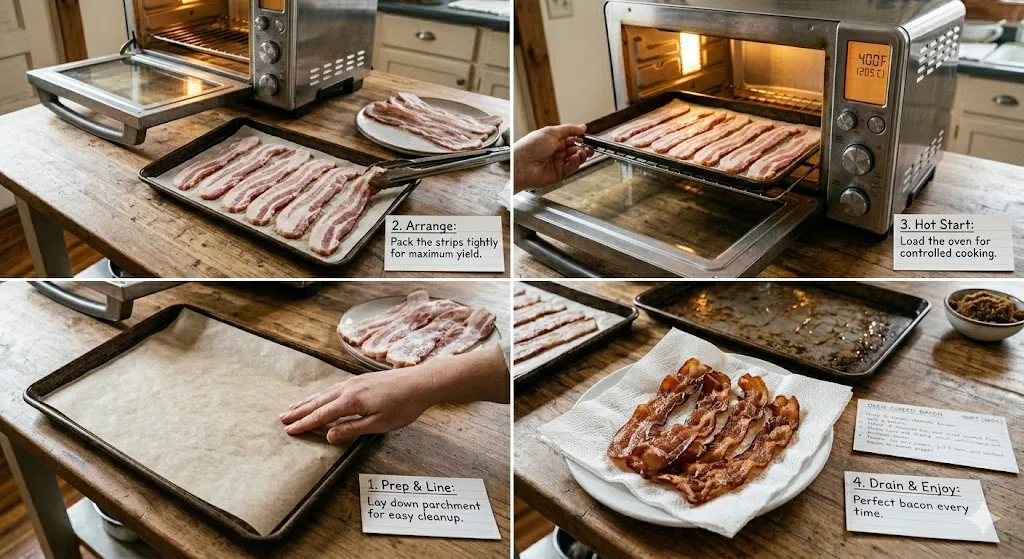
The key is even spacing and watching the final minutes closely. Bacon goes from perfect to overdone quickly.
Step by Step Instructions
- Preheat the oven to 400°F (or start in a cold oven for slower fat rendering).
- Line a sheet pan with parchment paper or aluminum foil.
- Arrange bacon in a single layer with non overlapping slices.
- Bake on the middle rack.
- Check at 12 minutes. Rotate the pan halfway if needed.
- Remove when deep golden brown and crisp.
- Transfer to a paper towel lined plate and blot excess grease.
Why This Method Works (The Science Behind It)
Bacon contains both fat and protein. As it heats, the fat begins to render around 130–140°F. If the oven temperature is too high too quickly, the exterior protein tightens before the interior fat melts leading to uneven texture.
The cold oven method works because it gradually raises the temperature, allowing fat to render slowly before browning accelerates. At 400°F, you hit the sweet spot: efficient fat rendering plus enough surface heat for the Maillard reaction that has a golden brown color and rich flavor.
Think of it like tempering chocolate. Slow control gives better structure.
Complete Bacon Type & Cut Reference Guide
| Bacon Type | Oven Temp | Time Range | Rack Recommended? | Notes |
| Regular sliced pork bacon | 400°F | 12–17 min | Optional | Most common |
| Thick cut bacon | 400°F | 20–25 min | Yes | Less splatter |
| Center cut bacon | 400°F | 12–15 min | Optional | Leaner |
| Turkey bacon | 375°F | 10–15 min | No | Cooks faster |
| Beef bacon | 375°F | 15–20 min | Yes | Higher fat |
| Pancetta slices | 375°F | 10–14 min | No | Watch closely |
| Uncured bacon | 400°F | 12–18 min | Optional | Slightly less salty |
Cooking for a Crowd: How Much Bacon Do You Need?
Bacon shrinks 30–50% during cooking. A 1 lb package yields roughly 12–14 slices raw.
| Guests | Slices Each | Raw Bacon Needed | Approx. Cost ($7/lb avg) |
| 4 | 3 | 1 lb | $7 |
| 8 | 3 | 2 lbs | $14 |
| 12 | 3 | 3 lbs | $21 |
For brunch, I always round up. Bacon disappears fast.
Troubleshooting: Why Did My Bacon Burn or Undercook?
If your bacon burned at 400°F for 20 minutes, several factors may be at play.
Convection setting adds roughly 20% more effective heat. Reduce temp by 25°F.
Dark baking pans retain more heat and brown faster.
Top rack placement increases browning speed.
Oven calibration issues are common; some ovens run 15–25°F hot.
If unsure, bake at 375°F and extend cook time.
What to Do With Bacon Grease (And How to Store It Safely)
Saving bacon grease is practical and flavorful.
How to Render and Store Bacon Grease
- Strain hot grease through a fine mesh sieve lined with cheesecloth.
- Let cool slightly.
- Pour into a glass jar.
- Label and refrigerate.
Shelf Life:
- Filtered grease: 3 months in fridge, up to 3 months in freezer.
- Unfiltered: 2–4 weeks in the fridge only.
Discard if it smells sour or looks cloudy.
Meal Prep & Storage: What Happens to Texture Over Time?
Crispy bacon softens within hours as it absorbs ambient moisture. Store in an airtight container layered with paper towels.
Storage Times:
- Refrigerator: 3 to 5 days
- Freezer: Up to 1 month (separate with parchment)
Reheating Comparison
| Method | Time | Result | Best For |
| 350°F oven | 5–7 min | Restores crisp | Large batch |
| Dry skillet | 2–3 min | Very crisp | Few slices |
| Microwave | 20–30 sec | Softens | Convenience |
Nutritional Context (Why Numbers Vary)
Nutrition varies based on brand and thickness. Shrinkage alters per slice values.
| Bacon Type | Approx Cal/Slice | Protein | Sodium | Fat |
| Pork bacon | 40–45 kcal | 3g | 150–190mg | 3–4g |
| Center cut | 30–35 kcal | 3g | Lower | 2–3g |
| Turkey bacon | 25–30 kcal | 2–3g | Lower | 1–2g |
Cooked weight differs from raw weight, which explains calorie variation online.
Pro Tip for the Best Oven Cooked Bacon recipe(The Trick Most Recipes Don’t Mention)
If you want evenly crisp, flat bacon with minimal curling, start the bacon in a cold oven instead of preheating.
Here’s why this matters: as the oven gradually heats, the fat begins to render slowly before the proteins tighten up. That slow rendering prevents the outside from seizing too quickly, which is what causes curled, uneven strips. The result is flatter bacon with better texture and more evenly distributed crispiness.
I use this method especially for thick cut bacon or when I want super crispy results without scorching the edges. Simply place the tray in a cold oven, then set it to 400°F and begin timing once the oven reaches temperature. It makes a noticeable difference.
Flavor Variations That Make Oven Cooked Bacon Recipe Even Better
Plain crispy bacon is fantastic. But when you want something special for brunch, holidays, or appetizers these variations elevate it beautifully.
The key is understanding that sugar burns faster, so glazed or sweet bacon should bake at 375°F instead of 400°F.
Flavor Variation Guide
| Variation | What to Add | When to Apply | Temp Adjustment | Notes |
| Brown Sugar Bacon | Light brown sugar | Before baking | 375°F | Turns deeply caramelized |
| Maple Glazed Bacon | Pure maple syrup | Last 5 minutes | 375°F | Brush lightly to avoid pooling |
| Black Pepper Crust | Fresh cracked pepper | Before baking | None | Bold and savory |
| Chili Brown Sugar | Brown sugar + chili flakes | Before baking | 375°F | Sweet heat |
| Everything Bagel Bacon | Everything seasoning | Before baking | None | Great for breakfast sandwiches |
| Rosemary Honey Bacon | Honey + minced rosemary | Last 5 minutes | 375°F | Watch closely — honey browns fast |
These are perfect for:
- BLT upgrades
- Bacon Deviled Eggs
- Cobb Salad
- Maple Bacon Brussels Sprouts
- Sweet and Spicy Ranch Bacon
Supporting Information: Why 400°F Is the Sweet Spot (But Not Always)
Most recipes default to 400°F because it balances fat rendering and browning.
At this temperature:
- Fat renders efficiently
- Moisture evaporates
- The Maillard reaction creates that deep golden brown finish
However, ovens vary more than most people realize. Convection ovens circulate hot air, effectively increasing heat intensity by about 20%. Dark sheet pans absorb more heat than light aluminum pans. A top rack position browns faster than the middle rack.
If your bacon keeps burning, try 375°F or even 350°F. Lower temperatures reduce splatter and allow more controlled fat rendering. This flexibility is why some cooks swear by 375°F instead of 400°F both are correct depending on your oven.
Storage, Freezing, and Reheating Best Practices (With Texture Notes)
Crispy bacon does not stay crispy indefinitely and most recipes don’t mention that. Within a few hours, even perfectly baked bacon softens as it absorbs ambient moisture and residual fat.
How to Store oven Cooked Bacon recipe
Let the bacon cool completely, then store it in an airtight container layered with paper towels to absorb excess grease.
Refrigerator:
- 3 to 5 days
Freezer:
- Up to 1 month (separate slices with parchment paper)
If you freeze bacon, stack 2 pieces together with parchment between layers so you can remove only what you need.
Best Reheating Methods for Restoring Crispiness
| Method | Time | Texture Result | Best For |
| 350°F oven on rack | 5–7 minutes | Restores crisp edges | Larger batches |
| Dry skillet | 2–3 minutes | Very crispy | Small portions |
| Air fryer | 2–4 minutes | Fast crisp | Quick snack |
| Microwave | 20–30 seconds | Softer texture | Convenience only |
If crispiness matters, avoid the microwave. Dry heat brings the texture back best.
What to Do With Bacon Grease (Full Safety Guidance)
Saving bacon grease is practical but storage matters.
How to Properly Store Bacon Grease
- Strain warm grease through a fine mesh sieve lined with cheesecloth or a nut milk bag.
- Let it cool slightly.
- Pour into a clean glass jar.
- Label with the date.
- Refrigerate.
Filtered bacon grease lasts longer because food particles accelerate spoilage.
Shelf Life
- Filtered grease: up to 3 months in refrigerator
- Unfiltered grease: 2–4 weeks refrigerated only
- Freezer storage: up to 6 months
If it smells sour, metallic, or rancid, discard it.
Use saved bacon grease for:
- Roasted vegetables
- Classic Meatloaf
- Garlic Herb Baked Cod
- Irish Lamb Stew
- Buffalo Cauliflower
- Creamy Tomato Basil Soup
It adds depth without needing much.
Why Variations and Storage Matter for Real Kitchens
Most people aren’t cooking bacon just once. They’re meal prepping, hosting brunch, or adding it to salads and sandwiches throughout the week.
Understanding:
- How bacon shrinks
- Why it softens
- How to restore crispness
- How sugar affects baking temperature
- How oven variability changes timing
turns this from a basic recipe into a dependable kitchen method. And that’s the difference between just baking bacon and mastering it.
Common Mistakes and Why They Ruin the oven cooked bacon Recipe
Overcrowding causes uneven cooking. High heat causes burnt edges. Not watching final minutes leads to overdone strips.
- Always cook in a single layer
- Check early
- Adjust for your oven
My Experience Making This at Home
The first time I baked bacon at 400°F, I walked away for 20 minutes and came back to nearly black strips. My oven runs hot. Now I check for 12 minutes and rotate the pan halfway.
The biggest improvement came when I switched to a heavy duty baking sheet and parchment paper. The bacon cooked flatter and more evenly.
Benefits of This Oven Cooked Bacon Recipe
Beyond flavor, this method offers convenience and consistency.
- Less mess than stovetop
- Ideal for large batches
- Even cooking
- Easier cleanup
FAQ Real Questions People Ask
Do I have to flip the bacon?
No. Oven heat circulates evenly, so flipping isn’t necessary unless using a rack.
What temperature should I cook bacon at?
400°F is the sweet spot. Use 375°F for gentler cooking or less splatter.
Does thick cut bacon need longer?
Yes. Expect 20 to 25 minutes.
Can I cook bacon in a cold oven?
Yes. It promotes slower fat rendering and even crispiness.
Can I freeze cooked bacon?
Absolutely. Separate slices with parchment and freeze for up to 1 month.
How do I make it extra crispy?
Use a rack and bake 1–2 minutes longer.
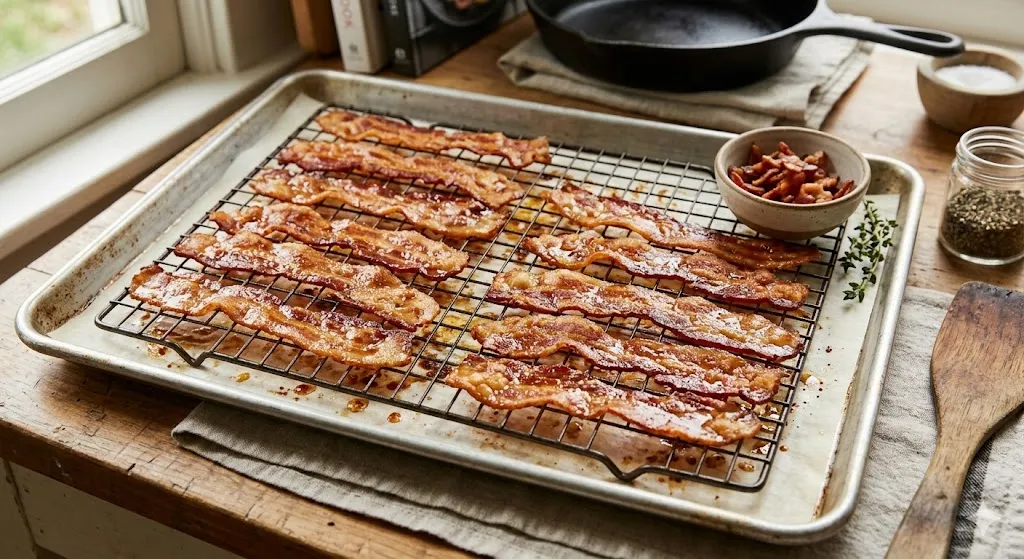

Oven Cooked Bacon Recipe
Ingredients
Equipment
Method
- Preheat oven to 400°F (200°C) and line a rimmed baking sheet with foil or parchment for easy cleanup.
- Arrange bacon slices in a single layer without overlapping; use a wire rack on top of the sheet if desired for extra crispiness.
- Place the baking sheet in the cold oven, then set to 400°F to help the fat render slowly.
- Check at the 15-minute mark; thinner bacon may finish sooner while thick-cut needs more time.
- Bake for 15–20 minutes until the bacon turns deep golden brown and crispy around the edges.
- Remove from oven and transfer bacon to a paper towel–lined plate to drain excess grease.
- Let cool for 2–3 minutes; bacon will crisp up slightly more as it rests.
Video
Notes
Conclusion
This oven cooked bacon recipe delivers consistent, crispy bacon without the stovetop mess. Whether you’re making breakfast for four or brunch for twelve, this method gives you control, even browning, and perfectly rendered bacon grease every time.
Bookmark this guide, experiment with the flavor variations, and let your oven do the work next time you cook bacon.