If you’ve ever stood in the kitchen staring at a jar of expensive avocado oil mayo wondering whether you could just make it yourself you’re not alone. I’ve been there too, especially after spending nearly a full bottle of avocado oil on a failed batch that never thickened. That moment is usually what pushes people to either give up or finally learn how mayonnaise actually works.
This avocado oil mayonnaise recipe is my go to version after years of testing, breaking emulsions, and learning what actually matters. It’s creamy, neutral in flavor, and takes just a couple of minutes once you understand the technique. The texture is thick enough for sandwiches but silky enough for dressings, and the flavor is cleaner than most store bought jars.
But before we jump in, let’s talk honestly: homemade mayo is not always cheaper or easier unless you understand what you’re doing.
Discover more homemade sauces like this avocado oil mayonnaise to elevate everyday meals with fresh, simple flavors.
Is It Actually Worth Making Avocado Oil Mayonnaise Recipe at Home?
One of the biggest questions people have is whether homemade avocado oil mayo is worth it compared to store bought versions like Chosen Foods or Primal Kitchen.
Here’s a realistic breakdown based on average U.S. pricing:
| Option | Cost per Batch | Cost per Tablespoon | Notes |
| Store bought premium (Primal Kitchen / Chosen Foods) | $8–$12 per jar | ~$0.50–$0.75 | Convenient, consistent |
| Homemade (Costco avocado oil + farm eggs) | $3–$5 per batch | ~$0.20–$0.35 | Cheapest if successful |
| Homemade (Whole Foods / organic oil) | $7–$10 per batch | ~$0.50–$0.70 | Similar to store bought |
| Failed batch (yes, it happens) | $8–$15 loss | N/A | Full oil wasted |
The truth most recipes don’t tell you: avocado oil is the most expensive variable, and failed emulsions erase any cost advantage immediately. If you’ve ever had mayo stay runny, you know exactly what I mean.
So is it worth it? Yes but only if you understand the technique.
What to Expect: Homemade vs Store Bought Taste (Real Talk)
Homemade avocado oil mayonnaise tastes noticeably different from commercial brands.
Fresh homemade mayo is:
- Slightly richer and more “eggy” in the first few hours
- Less artificially white (more pale yellow)
- Cleaner in flavor with no additives or stabilizers
- Softer in texture after 2–3 days
Compared to store bought like Hellmann’s or Chosen Foods:
- Store bought is more uniform and shelf stable
- Homemade tastes fresher but less “engineered”
- Texture can feel more luxurious but less firm over time
If you expect identical results, you might be disappointed. If you expect fresher flavor, you’ll love it.
If you love bold heat, this Diablo Sauce Recipe adds a smoky, spicy kick that instantly upgrades any homemade meal.
What Is Avocado Oil Mayonnaise Recipe and Why It’s Popular
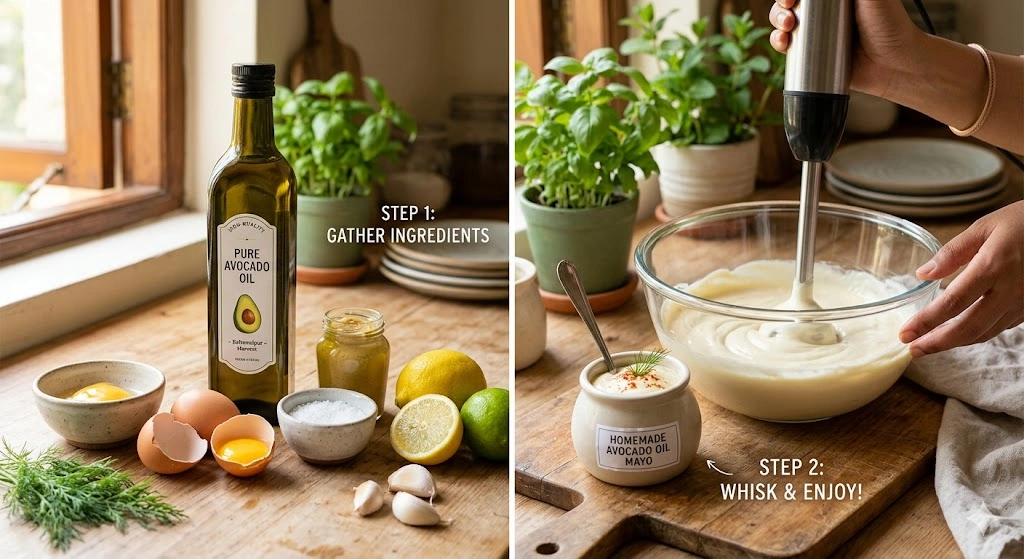
At its core, this is simply mayonnaise made by emulsifying avocado oil with egg yolks (or whole eggs), acid like lemon juice or vinegar, and mustard.
It became popular during the paleo and Whole30 movement because it replaces inflammatory seed oils like soybean or canola oil with monounsaturated fat rich avocado oil. These fats are often associated with heart healthy diets and cleaner eating approaches.
People keep making it because:
- It’s fast (under 2 minutes)
- It avoids preservatives like EDTA and modified starches
- It fits keto, paleo, and gluten free lifestyles
- It tastes fresher than most store versions
What Exactly Is Avocado Oil Mayonnaise recipe?
Avocado oil mayonnaise is an oil in water emulsion, meaning tiny oil droplets are suspended in a water based mixture stabilized by egg yolk lecithin.
Egg yolks act like a natural bridge between oil and water. Without them, the mixture separates instantly.
Most people don’t realize mayonnaise is less about mixing and more about controlling how oil breaks into microscopic droplets and stays suspended.
The Science in 60 Seconds (Why This Actually Works)
Egg yolk contains lecithin, a molecule with two “personalities”:
- One part attracts water
- One part attracts oil
This allows it to stabilize the emulsion so oil droplets don’t recombine.If you add oil too quickly or use cold ingredients, the emulsion can’t form properly. This is when mayo “breaks” into a watery mess.Think of lecithin like a tiny mediator holding oil and water together in balance.
Drizzle this Fire Honey Recipe over pizza or fried chicken to add a perfect balance of sweet heat that transforms every bite.
Avocado Oil Mayonnaise Recipe OVERVIEW
This avocado oil mayonnaise recipe is one of those kitchen basics that feels almost magical once it works. It’s thick, creamy, and emulsified into a smooth, spreadable texture that’s perfect for sandwiches, salads, and dips. The flavor is clean and neutral when made with refined avocado oil, with just a light tang from lemon juice or vinegar.
What makes it especially popular is how quickly it comes together. In under 2 minutes, you can go from raw ingredients to a fully formed homemade mayo with no stovetop, no cooking, and almost no cleanup if you use a jar. It’s the kind of recipe that fits into keto, paleo, Whole30, and low carb lifestyles without feeling restrictive.
This mayo works best when you want something fresh and customizable. It holds up beautifully in chicken salad, coleslaw, and pasta salad, but also spreads smoothly on sandwiches or burgers without overpowering other flavors.
| Detail | Information |
| Prep Time | 5 minutes |
| Blending Time | 1–2 minutes |
| Total Time | ~5–7 minutes |
| Servings | About 1 cup |
| Difficulty | Easy (once technique is learned) |
| Cuisine | American / Condiment |
| Yield | 15–16 tablespoons |
Ingredients and Why Each One Actually Matters
You don’t need many ingredients, but each one has a job.
- 1 whole egg (room temperature preferred) provides lecithin for emulsification
- 1 cup avocado oil (refined preferred) main fat base for texture and stability
- 1–2 tsp lemon juice or vinegar adds acidity and helps stabilize the emulsion
- 1 tsp Dijon mustard improves emulsification and adds flavor depth
- ½ tsp sea salt enhances flavor and balances richness
Important Oil Note (Most Recipes Skip This)
Not all avocado oils behave the same.
- Refined avocado oil (BEST choice): pale yellow, neutral smell, stable flavor
- Unrefined / extra virgin avocado oil: darker green, grassy taste, can turn bitter mayo
If your mayo ever tastes bitter or greenish, this is almost always why.
Egg Type Matters More Than You Think
Eggs aren’t interchangeable in emulsions.
| Egg Type | Effect on Mayo | Notes |
| Large egg | Standard result | Most consistent |
| Medium egg | Slightly thinner mayo | May need less oil |
| Extra large egg | Thicker emulsion | Very stable |
| Yolk only | Richest texture | Best for whisk method |
Farm fresh eggs often create richer flavor due to higher fat content in yolks.
Equipment: What Works Best (And What Doesn’t)
Not all tools give the same results.
| Method | Success Rate | Texture | Cleanup | Skill Level |
| Immersion blender | Very high | Thick & creamy | Easy | Beginner |
| Food processor | High | Slightly softer | Medium | Beginner |
| Whisk by hand | Medium low | Dense but inconsistent | Hard | Advanced |
The immersion blender wins because it creates a strong emulsifying vortex at the bottom of a narrow jar.
How to Make Avocado Oil Mayonnaise recipe(Step by Step)
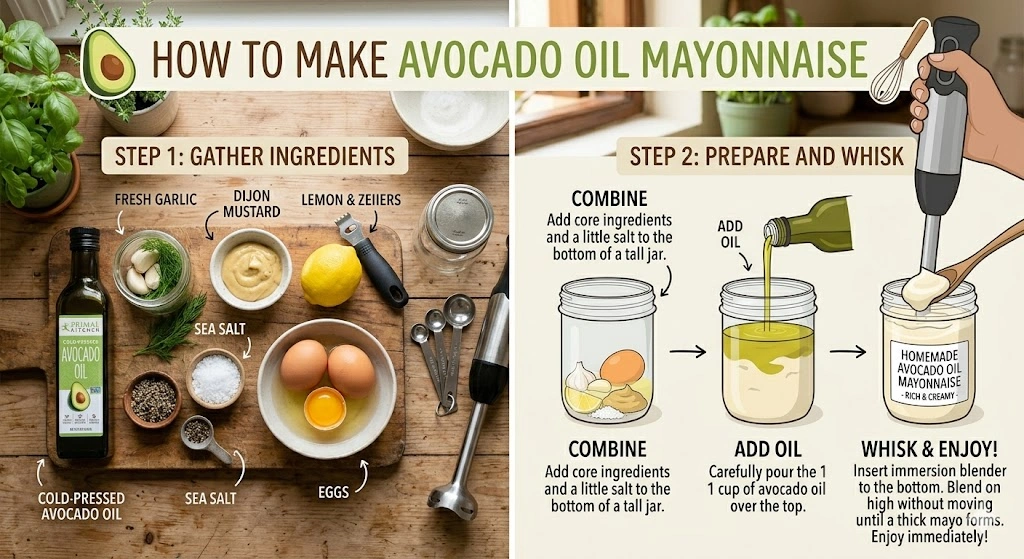
Once you understand the setup, this is incredibly fast.
- Add egg, lemon juice, mustard, and salt into a wide mouth jar.
- Pour avocado oil on top without mixing.
- Place an immersion blender at the bottom of the jar.
- Turn it on and hold still for 10–15 seconds until it thickens.
- Slowly lift the blender upward to incorporate remaining oil.
- Blend another 10–20 seconds until fully creamy.
The entire process usually takes under 2 minutes once it starts emulsifying properly.
Pro Tip for Perfect Mayo Every Time
Always start blending from the bottom and do NOT move the blender until you see thickening happen.
This matters because the bottom layer creates the initial emulsion “base.” If you move too early, you never build structure and the oil stays separated.
Common Mistakes That Ruin Avocado Oil Mayonnaise Recipe
Most failures come from just a few predictable issues:
- Adding oil too quickly before emulsification begins
- Using cold eggs straight from the fridge
- Using unrefined avocado oil with strong flavor
- Incorrect jar size (too wide = weak vortex)
- Starting blender too high instead of at the bottom
Key takeaway: emulsification is timing, not effort.
Troubleshooting Broken Mayo (What Went Wrong & How to Fix It)
If your mayo fails, here’s how to diagnose it:
| Problem | Likely Cause | Fix |
| Never thickened | Oil added too early | Restart with new egg |
| Broke mid way | Too much oil too fast | Add another egg slowly |
| Thin but stable | Ratio imbalance | Add more oil gradually |
| Broke in fridge | Temperature shift | Re emulsify with egg |
| Bitter taste | Unrefined oil | Switch oil type |
If it breaks mid process, don’t panic, you can often save it with a fresh egg and slow blending.
Variations and Smart Substitutions
This recipe is flexible, but changes matter.
- Lemon juice → apple cider vinegar (slightly sharper flavor)
- Dijon mustard → yellow mustard (milder, less depth)
- Avocado oil → light olive oil (stronger flavor, less neutral)
- Egg free → aquafaba (less stable, vegan option)
- Add ins → garlic, chipotle, herbs for flavored mayo
Each substitution slightly changes stability and taste, so expect differences.
My Personal Experience Making This Avocado Oil Mayonnaise Recipe at Home
The first time I made avocado oil mayo, I thought I had failed the moment it turned watery. I didn’t realize I had simply lifted the blender too early. The second attempt worked perfectly and it was shocking how fast it came together.
The biggest lesson I learned is that mayo is not forgiving of hesitation. Once you commit to emulsifying, you need to trust the process.
Looking for more ideas like this? Explore more delicious recipes on Cookiva Recipe and upgrade your everyday cooking.
BENEFITS OF AVOCADO OIL MAYONNAISE RECIPE
Making your own Avocado Oil Mayonnaise Recipe isn’t just about flavor it’s also about control over ingredients and quality. Many store bought versions contain preservatives, stabilizers, and processed seed oils, while homemade versions let you choose exactly what goes in.
One of the biggest benefits is the use of avocado oil itself. It’s naturally rich in monounsaturated fats, which are often considered a more stable and neutral fat source compared to heavily processed oils. This gives the mayo a clean taste without the heaviness that some commercial versions have.
Another advantage is customization. You can adjust acidity, salt level, or thickness depending on how you plan to use it. Whether you want a thicker sandwich spread or a looser dressing base, small changes completely transform the result.
Key Benefits:
- Often contains fewer additives than store bought mayo
- Can be made fresh in under 2 minutes
- Fully customizable flavor and texture
- Works in keto, paleo, and gluten free diets
- Uses simple pantry ingredients
This is the kind of recipe people return to because it becomes a base for so many other sauces and meals.
SUPPORTING INFORMATION WHY THIS RECIPE WORKS SO WELL
Understanding why this avocado oil mayonnaise recipe works helps you become much more confident in the kitchen, especially if you’ve ever had a failed batch.
At its core, mayonnaise is a stable emulsion, meaning it’s a mixture of two liquids that normally don’t combine oil and water. Egg yolk contains lecithin, which acts like a natural bridge between these two worlds. It surrounds tiny droplets of oil and keeps them suspended evenly throughout the mixture.
This is why technique matters so much. When oil is added too quickly, the lecithin can’t stabilize it, and the mixture “breaks,” separating into liquid and oil layers. When done correctly, the oil is broken into microscopic droplets that stay evenly distributed, creating that thick, creamy texture we associate with mayonnaise.
Another important factor is temperature. Room temperature eggs allow lecithin molecules to move more freely, improving emulsification success. Cold ingredients slow everything down and make it harder for the structure to form.
Even something as simple as jar width matters. A narrow container helps the immersion blender create a strong vortex that forces oil into smaller droplets, improving stability and thickness.
Once you understand this, mayonnaise stops feeling like guesswork and starts feeling like controlled chemistry in your kitchen.
Storage, Shelf Life, and Food Safety
Homemade mayo should always be stored in an airtight glass jar in the fridge.
Typical storage ranges:
- 5–7 days (standard eggs, fresh batch)
- Up to 2 weeks (very fresh eggs, acidic mix)
Signs it has gone bad:
- Sour or off smell
- Watery separation
- Change in color or texture
If using raw eggs concerns you, pasteurized eggs reduce risk significantly.
FAQs About Avocado Oil Mayonnaise Recipe
Why did my avocado oil mayo turn green or bitter?
This usually happens when unrefined avocado oil is used. Refined oil is much more neutral and stable for emulsions.
Can I make this without an immersion blender?
Yes, but food processor or whisking requires slower oil incorporation and more patience, with lower success rates.
Why did my mayo break halfway through?
This is often caused by adding oil too quickly before the emulsion fully forms.
Is homemade mayo healthier than store bought?
It avoids preservatives and seed oils, but calorie content is similar.
Can I freeze avocado oil mayonnaise?
No, freezing breaks the emulsion permanently.
Why is my mayo too thin?
Usually a ratio issues too little oil or insufficient emulsification time.
Can I use olive oil instead?
Yes, but expect a stronger flavor and slightly different texture.

Avocado Oil Mayonnaise Recipe
Ingredients
Equipment
Method
- Add egg, lemon juice, mustard, salt, and vinegar into a wide-mouth jar; ingredients should settle at the bottom.
- Pour the avocado oil gently on top, allowing it to sit above the egg mixture without mixing.
- Insert the immersion blender to the bottom of the jar, fully covering the egg mixture.
- Turn on the blender and keep it still for about 10–15 seconds until the bottom turns thick and pale.
- Slowly lift the blender upward as the mixture emulsifies, creating a creamy texture throughout.
- Continue blending until all oil is incorporated and the mayonnaise is thick and smooth.
- Taste and adjust salt or lemon juice if needed for balance.
- Transfer to a sealed container and refrigerate immediately.
Video
Notes
Final Thoughts
This avocado oil mayonnaise recipe is simple once you understand the science behind it but it’s also unforgiving if you rush. The difference between perfect mayo and a broken mess is usually just seconds of technique.
Once you get it right, though, it becomes one of those kitchen staples you’ll never want to buy again.If you try it, save this recipe you’ll probably come back to it more often than you expect.
This Ham Gravy Recipe is a simple way to turn leftover drippings into a rich, savory sauce that elevates any comfort meal.